


[What follows is an open letter to the knitting community. See below for everyone who signed on. See CatBordhi.com for more about Cat’s legacy, and Val Curtis’s part in keeping it alive.]

Cat Bordhi was one of the most creative people we’ve ever known, and one of the most generous.
Many people know her creativity through the patterns and unique ideas that she sent forth into the knitting community. Not as many know about her exquisitely crafted bears or the prize-winning young adult novel she wrote.
Her generosity burst forth in her teaching, in school systems where she helped the curriculum come alive and lose its confusion for students, and then in the fiber world, where she came up with inventive ways to teach not only skills but an approach of joyous experimentation and discovery.
Throughout much of this time, Cat experienced cancer. She held it off with her characteristic enthusiasm for many years. We lost her in the fall of 2020, as the covid-19 pandemic was upending multiple aspects of our lives.
Cat’s clear-sighted awareness meant she knew that she would be leaving us, and she knew she had built a legacy. She knew that legacy would need an attentive guardian, and she asked some friends to be its guardians. Chief among those guardians is her good friend, Val Curtis, who bravely agreed to continue maintaining Cat’s website, original works, patterns, and books and to do everything possible to make sure the knitting community has ongoing access to the incomparable and valued resources Cat had generated over so many years. Cat asked that her daughter, Jenny, and Val come to an agreement that they both felt was fair with regards to compensation and they did. They, too, are dear friends. Jenny used to be Val’s next-door neighbor and their boys were babies together.
As organized as Cat’s public presence was, behind the scenes that abundant, inventive spirit left more good stuff than we have seen yet, things that need to be shaped into shareable formats. In some cases these need to be made out of scraps and crumbs that Cat left behind: enough to work with, but not enough to make that job simple or straightforward.
Preserving Cat’s legacy is a job Val volunteered for and has taken on with alacrity and dedication. But to do this, she needs our support: emotional, for sure, and with an appreciation for her time and effort and skills (which, as Cat knew, are plentiful). She has played many roles in Cat’s absence to keep the community afloat. This has ranged from emotional support to Cat’s beloved friends to keeping the spirit of Cat’s Silent Knitting group via bi-weekly Zoom gatherings and developing Test Knit groups to piece together patterns that are almost complete.
While Val has felt the love, kindness, and creativity of Cat’s community, a number of us would like to make more widely known and acknowledged the yeoman work she has done in maintaining that community.
Val is not Cat. NO ONE is or can be Cat. But with fortitude and a generosity akin to Cat’s, Val—with the support of everyone who has benefited from or will benefit from the resources that Cat left us, in every form—is willing to do her best to keep Cat Bordhi’s spirit active and inspiring our work and lives. That “best” is remarkable, and those of us who know the work Val has put in behind the scenes are both grateful and amazed.
This letter comes as an appeal from many of Cat’s friends and associates: let’s all pitch in and give Val the appreciation her work deserves. Let’s also make a team effort to keep the magic going, to the best of our ability.
This is how we all can honor the treasure that Cat was.
Lorilee Beltman
Anne Berk
Janine Bajus
Judy Becker
JC Briar
Beth Brown-Reinsel
Ann Budd
Pamela Wynne Butler
Carson Demers
Franklin Habit
Sivia Harding
Amy O’Neill Houck
Marta McCall
Jamie McCanless
Sandra McIver
Sunne Meyer
Syne Mitchell
Alasdair Post-Quinn
Andrea Price
Sean Riley
Deborah Robson
Gayle Roehm
David Roth
Karin Skacel
Myrna Stahman
Jeny Staiman
Nancy Thompson
Jill Wolcott
Those of you that know Myra Wood know that she’s exceptional in oh so many ways: Her creativity. Her skill in creating free-form works of art in knitting, crochet, and beading. Her exquisite color sense. Her generous teaching spirit. And, most recently, her incredibly positive attitude while dealing with breast cancer.
So when a group of us decided to make her an afghan, I felt a little antsy. The parameters were clear: create a strip 8″ wide and 10′ long, out of HiKoo CoBaSi DK. But how was I supposed to do that? What sort of contribution would be appropriate, keeping the amazing recipient in mind?
You have to understand, I don’t do free-form work. I like a fairly clear idea of where I’m headed before I set out. So, initially, I considered knitting a long strip using multi-directional scarf techniques. But that idea fizzled out in the planning stages: I couldn’t figure out how I wanted to arrange the triangles and diamonds. I couldn’t see where to put the various colors. Trying to pin down a design left me stymied and frustrated.
Next I considered a series of small crocheted squares. A handful patterns, each done a few times with different color schemes… yeah, that could be fun. Even a little improvisational. I got out my stitch dictionaries and starting playing around. But after crocheting a few squares, each a little different in size, I considered the hassle of ensuring they’d all add up to a strip of the right size. Um, no, thanks.
Staring at those first few squares, I contemplated a new design plan: Create nine 8″ squares, each with a crocheted motif at the center and – here’s the kicker — a knitted lace border. I’ve been playing with lace wedges lately, so why not? Knitted rows tend to be shorter than crocheted rows, and so with a repeated lace pattern, I figured I’d have a decent chance of making all nine squares the requisite size.
That’s when I set down a couple more rules for myself:
- The crocheted center would be different for each of the nine squares. Ditto the lace border.
- Each crocheted motif would use a variety of colors, but each lace border would be a single color.
Now the project got seriously fun. It wasn’t completely planned, but it wasn’t free-form either: the project had just enough structure that I could pick a crochet motif out of a stitch dictionary, and pick colors that would work for that motif, without worrying about the other motifs or their colors. I could pick a lace pattern for a square, without worrying about which lace patterns I’d use for the other squares.
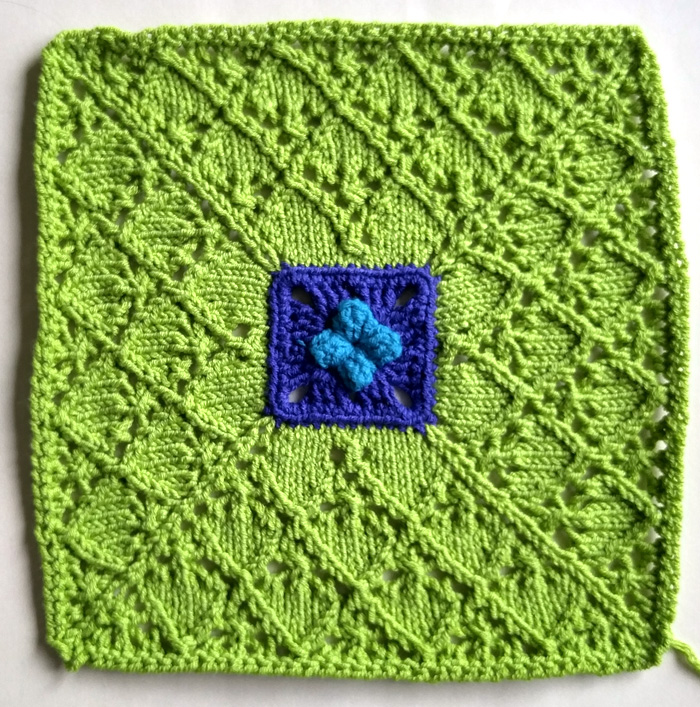
Larger crochet motifs warranted lace patterns with a smaller repeat, so a decent number of lace repeats would be visible:
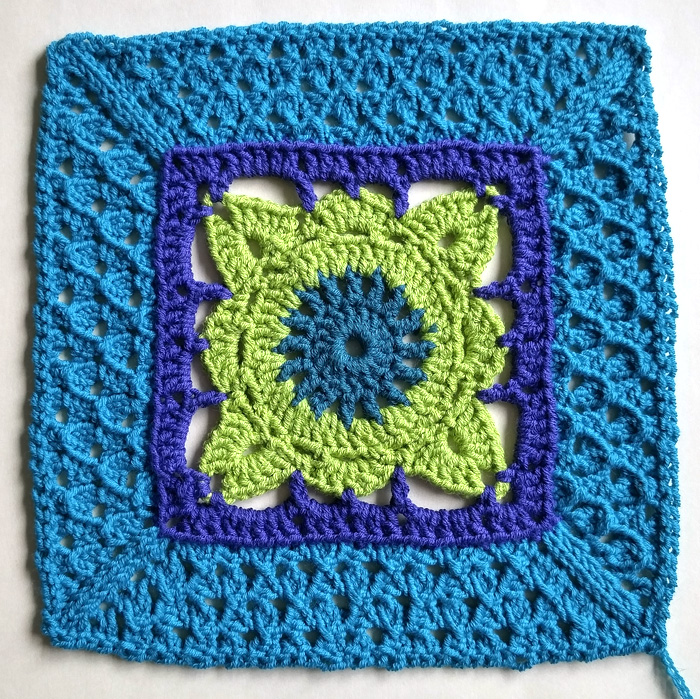
On the flip side, the smallest crochet motif made it possible to use a lace pattern with a fairly large repeat:
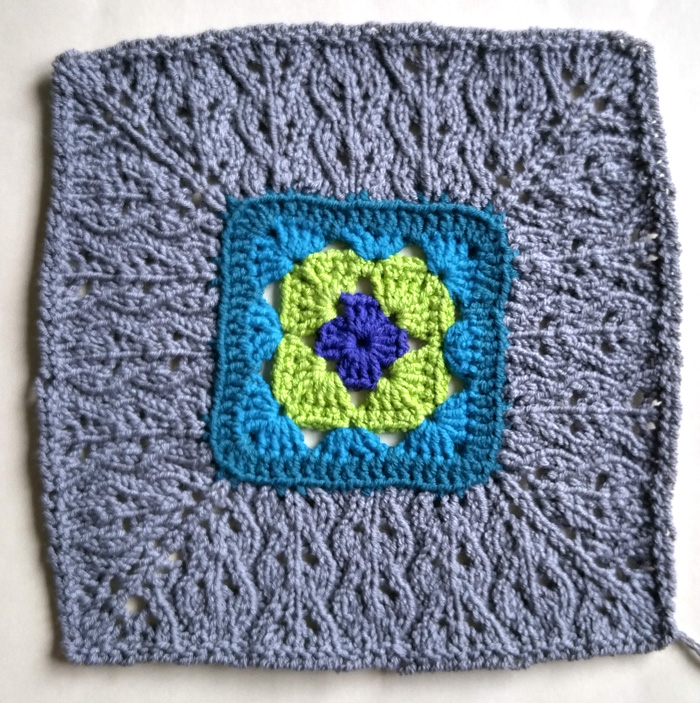
A vibrantly colored center could be paired with a more subdued border:
Each lace border was worked into stitches picked up in the back loops of the final round of a crocheted motif, creating a tiny frame of front loops around the motif. Likewise, ending each border with a p2tog bind-off created a tiny frame of purl bumps:

And those purl bumps meant that if I reached the end of a lace motif before getting a square of the right size, I could just add in a few quiet rows of garter stitch:
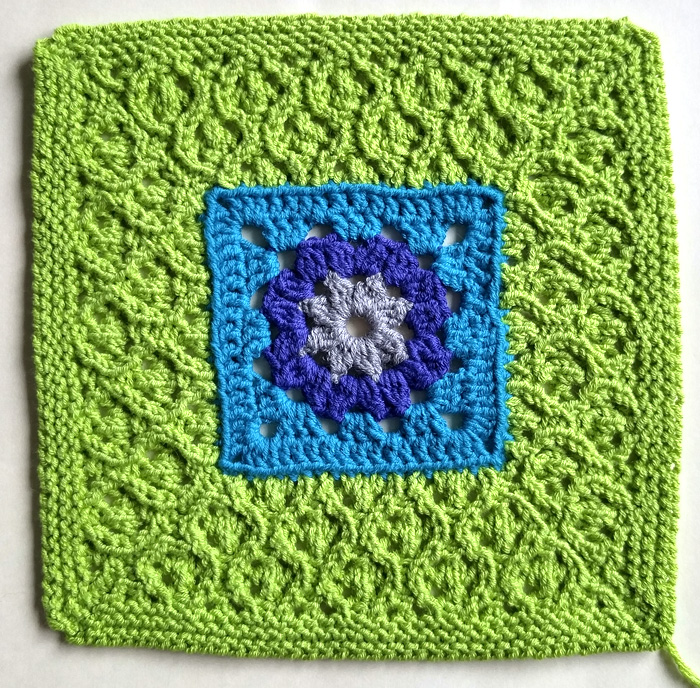
In the end, not all of the squares were that exciting:
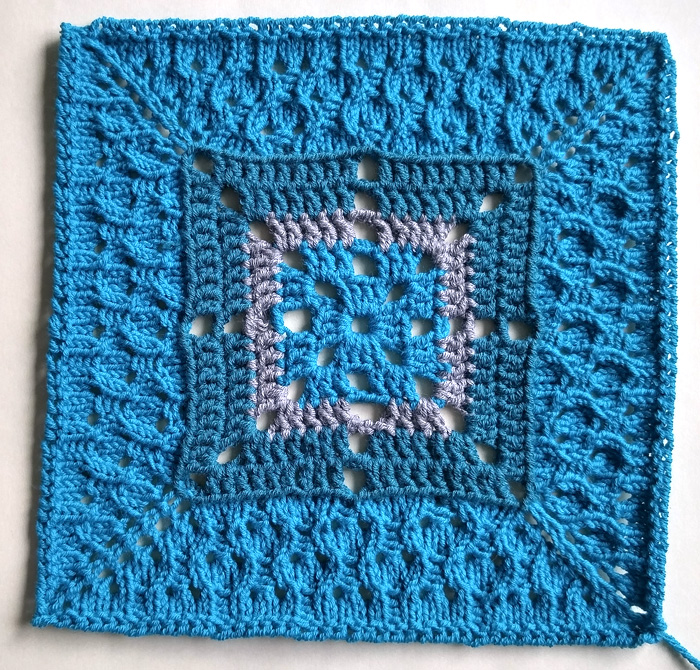
But I liked the textures I was seeing:
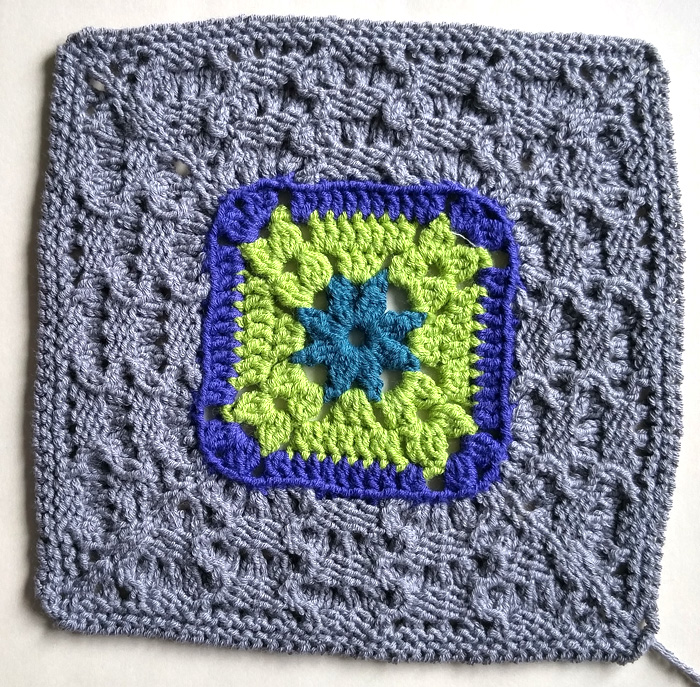
And I really liked how this very circular crochet motif paired with this lace pattern full of strong diagonals:
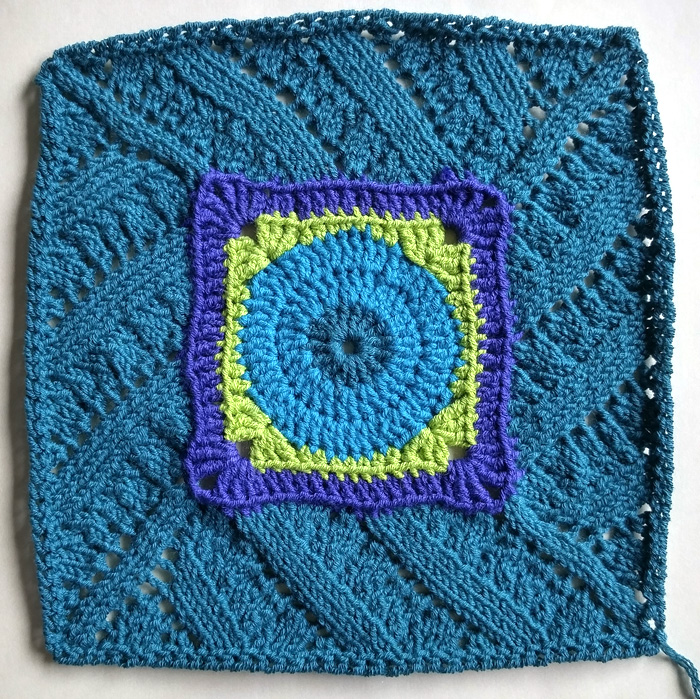
And a serendipitous outcome: the way the undulating rows of Traveling Vine pulled this crochet center into an undulating shape of its own:
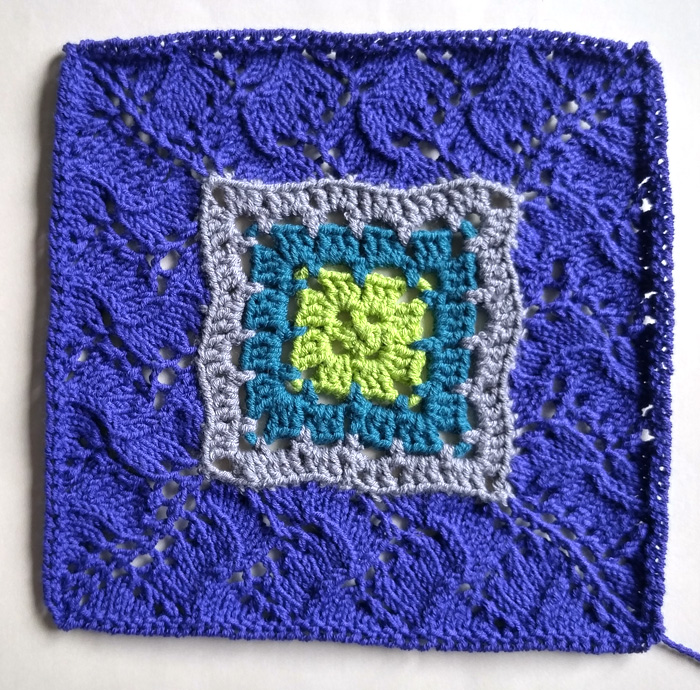
Once all the squares were done, I used their tails to sew them together, ensuring that no two squares of the same border color were adjacent:
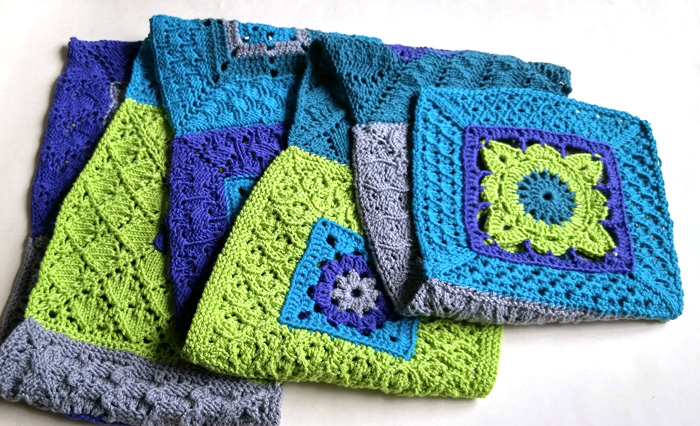
And that was that, except of course for joining all the strips together and giving the afghan to Myra. It would seem that she liked it. And she says she was able to guess who did each strip. I wonder what gave mine away?
I try not to get too smarmy in this blog, but this time it’s for a good cause.
Today through March 13, Craftsy is celebrating National Craft Month in a novel way: anyone who signs up for a class gets entered in a contest to win $1000 towards the craft-based charity of their choice. Knitted Knockers springs to mind. Ditto Halos of Hope… but it’ll be your choice!
Teachers who bring in new students are also given a chance to win. If I win, I promise to give my proceeds to my derby league, the Sick Town Derby Dames, aka Willamette Roller Derby. We’ve been struggling through a rough patch lately, what with the need for expensive repairs to our rink. Any extra cash could really help us complete the repairs, get skating again, and re-start our junior derby program for girls under 18. (Bonus! We’re a 501(c)3 non-profit, so donations are tax-deductible. Contact me if you’re feeling generous!)
So taking a Craftsy class is a win-win for everybody, right? A chance for you to win for your charity, a chance for me to support my derby league. And the classes are awesome! Check out the full list.
Over the next couple weeks, I’ll post highlights of classes I’d like to take, one from each of Craftsy’s 16 categories, to my Facebook page. Who knows? I might tempt you with a class you’d never considered.
Alexa
By JC | September 21, 2015
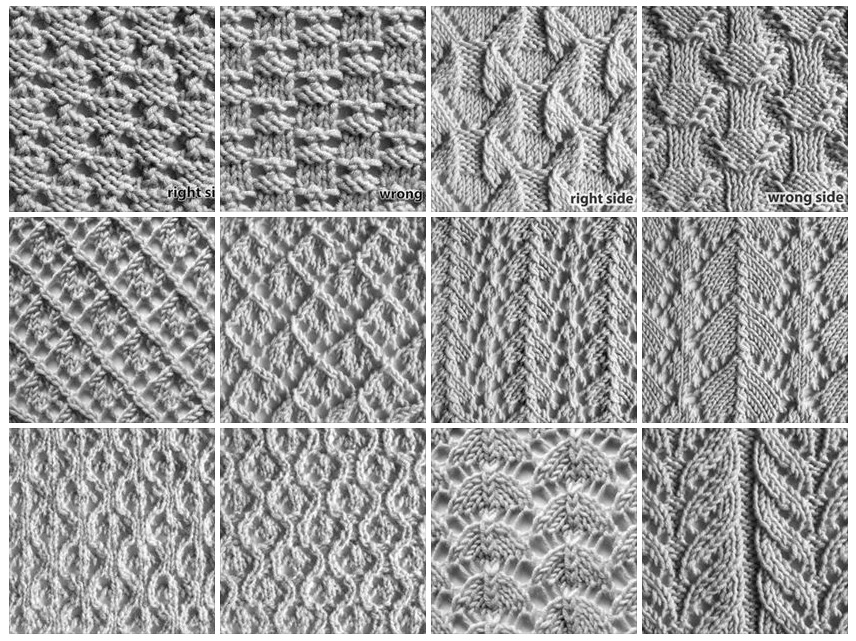
Those of you that follow me on Facebook know that I have a thing for swatching. I even went through a phase of regularly posting swatch photos.
 .
.
That phase has kind of fizzled out, but I’m still swatching. Case in point: a swatch for a wedge version of Ogee Lace from Barbara Walker’s A Treasury of Knitting Patterns.
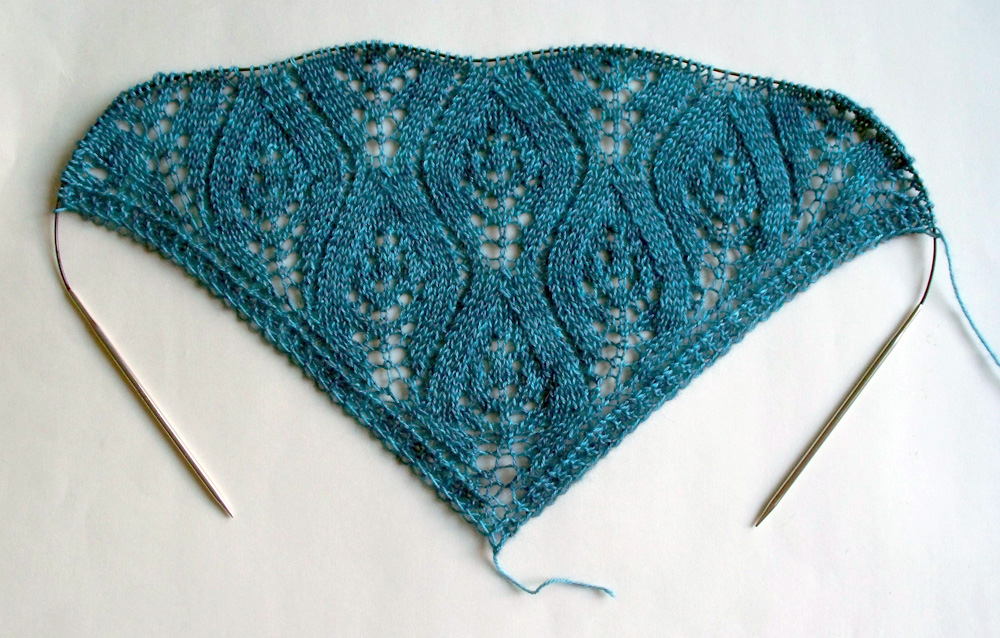
When I started the swatch in June, I suspected that it would continue to grow into a shawl. As it turns out, I guessed right. Meet Alexa, a wedge shawl composed of a single wedge knit from the bottom up.
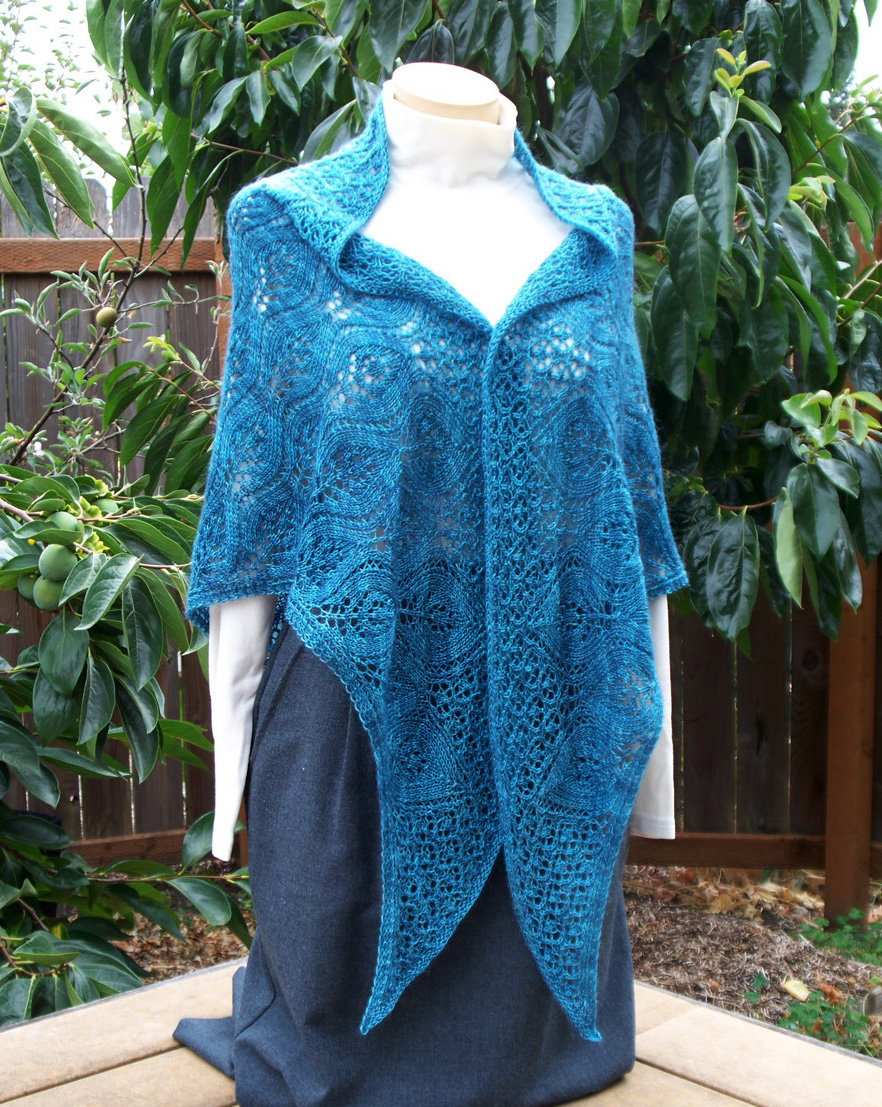
Much of the shawl is knit in Ogee Lace, but it’s finished with a top border of Fleurette.
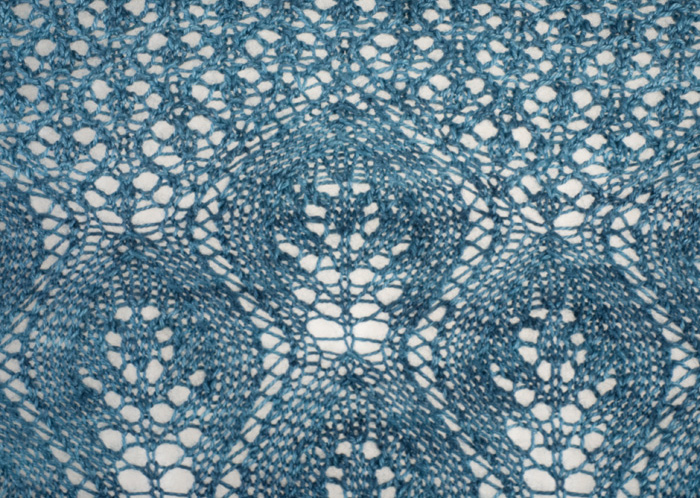
I’m pretty happy with how it turned out. The wedge grows rather rapidly, so the shawl isn’t overly long – you don’t need to fear sitting on its bottom point – but the two long ends drape nicely over your upper arms.
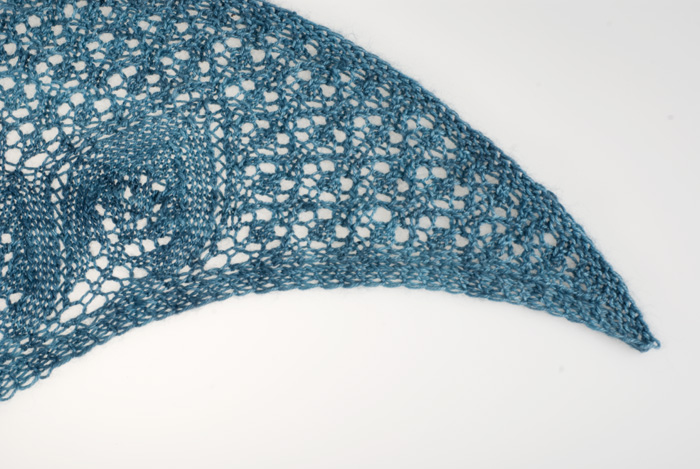
And did I mention that I’m in love with the yarn? Sophisticate, from the Plucky Knitter. It’s a blend of wool, mohair, and silk. So you get body, drape, sheen, and a touch of halo. Yum!
Alexa is now available on both Ravelry and Patternfish. But if you want to learn to design a wedge shawl of your own, check out my class at VK Live in Chicago.
Q&A
By JC | June 1, 2015
Ask anyone who’s been teaching knitting at the “big” events for a couple years (or anyone who’s done a fair bit of designing, I suppose), and they’ll tell you they regularly get questions via email. I thought it might be fun to share with you a few of my recent q&a sessions.
. . . . . . . . . .
I had such a great time in Lace Basics at Stitches South. Hope to see you next year. I need a recommendation for high quality blocking wires. There are many choices but seems there are comments in each that make me question the purchase. Price is not really a consideration as I believe you buy the best, once!
-D
Hey, D. I don’t know if my opinion will be of much help, since I’ve only ever owned one set of blocking wires. You might have more luck asking in a lace group on Ravelry.
But I can tell you this: Look for a set that includes both wires that won’t bend for blocking straight edges and thinner, more flexible wires for blocking curves. Look also for wires with smooth, slightly tapered tips that’ll make it easier to insert the wires into your selvedges. Bonus points, of course, for larger sets with more wires.
. . . . . . . . . .
I am going to take the Wedge Shawl Design class at Stitches Midwest and was wondering about yardage needed for the project. I will be using fingering weight yarn. Is there a guideline you use?
-C
Yardage amounts can vary widely. A couple skeins of fingering-weight yarn ought to give you a medium-size shawl. But if you want to make a better estimate, check out the shawl patterns on Ravelry. For shawls of the type and size you hope to make, how much yarn do they use?
. . . . . . . . . .
I hope you don’t mind me contacting you, but a friend and I plan to sign up for your Slick Set-in Sleeves class at Stitches Texas and have a question about materials. Since the sample sweater will be for a child, is it okay to use an acrylic yarn, such as Red Heart Classic or Wintuk? I have some in my stash that’s of worsted weight, and this would be a good way to put it to use.
-T
T, I don’t mind if you and your friend use acrylic yarn, provided you actually like knitting with that yarn. Stated another way: I would prefer that you came to class with yarn that you liked rather than with yarn that you’d fight with throughout class. All too often, I see students struggling with old stash yarn they don’t care for, but feel the need to use up. Unfortunately, it doesn’t make for a good learning environment. Does that make sense?
Cogitating
By JC | April 19, 2015
One of the things I’ve always wanted Stitch-Maps.com to be able to do is highlight the spaces between stitch columns.
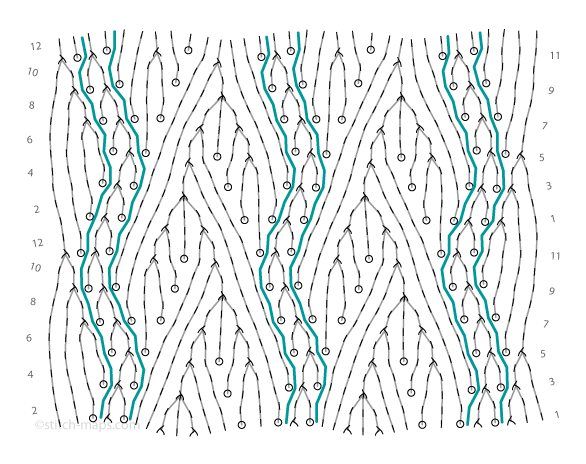
Or, to put it another way, to break a stitch pattern into its constituent parts.
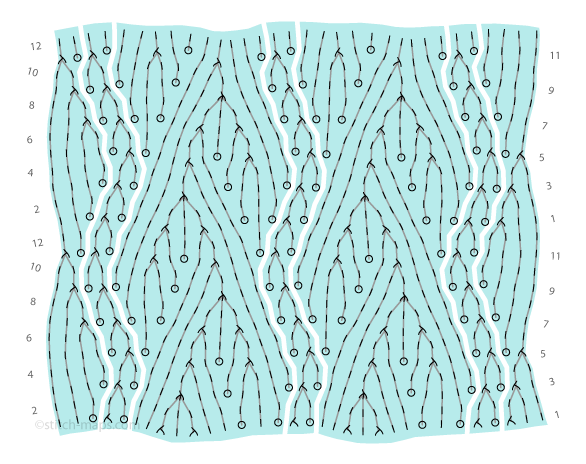
Having Stitch-Maps.com create these visualizations automagically would be awesome fun, not to mention super useful.
-
You could see where to place stitch markers that would never get caught in decreases, cable crosses, clusters, or gathers.
-
You could find the stitch pattern’s “true” repeat – especially handy when converting flat instructions for use in the round.
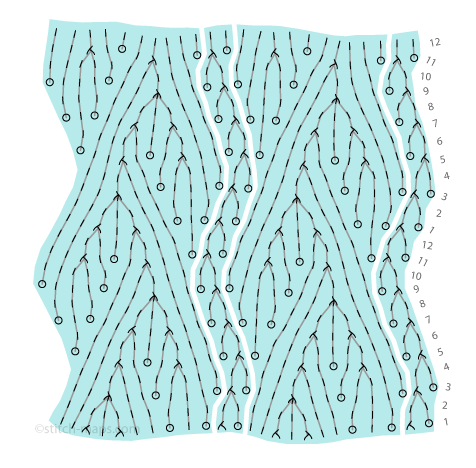
-
You could create new stitch patterns, by duplicating, removing, or replacing parts of an existing stitch pattern.
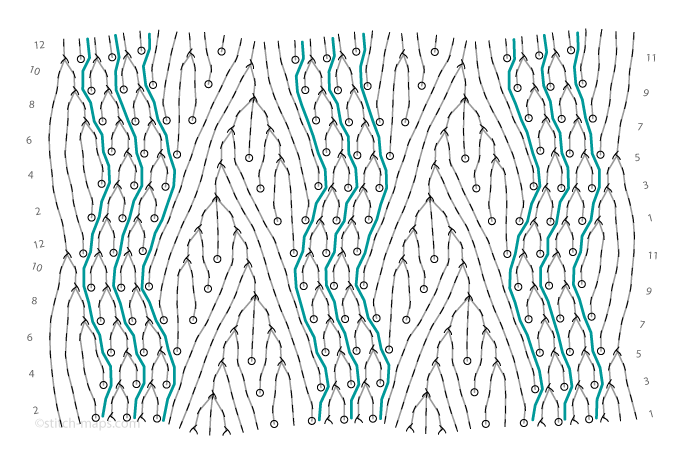
But as much as I want this to happen, I’m not exactly sure how it should work. It kind of depends on the stitch pattern in question, and what you’re trying to do with it.
Take Fleurette, for example. Highlighting all the between-stitch-column spaces gives a jumbled mess.
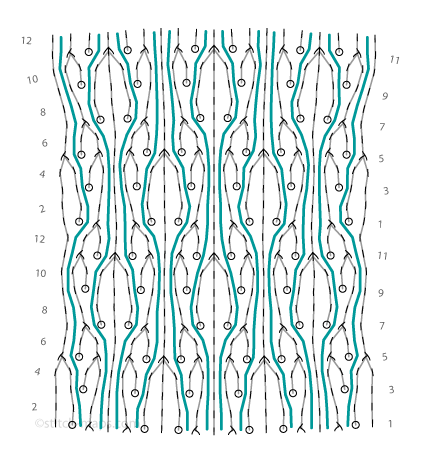
Sure, these lines show where you could put stitch markers. But it’d probably be more useful to highlight the pattern repeat.
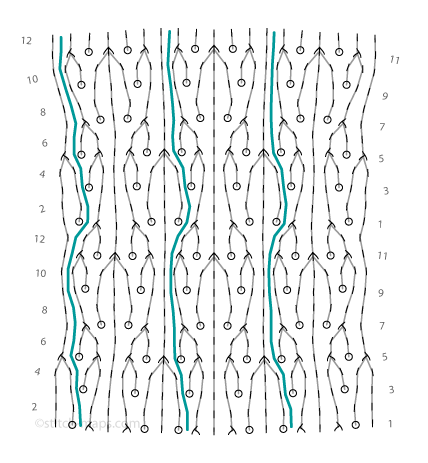
Or is this the repeat?
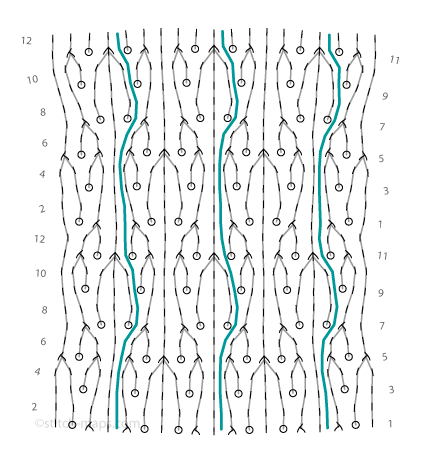
(Actually, Fleurette’s repeat could be defined four different ways. All are equally valid.)
Another example: Trellis Lace. There’s only one spot you could put a marker that would never get caught in a decrease.
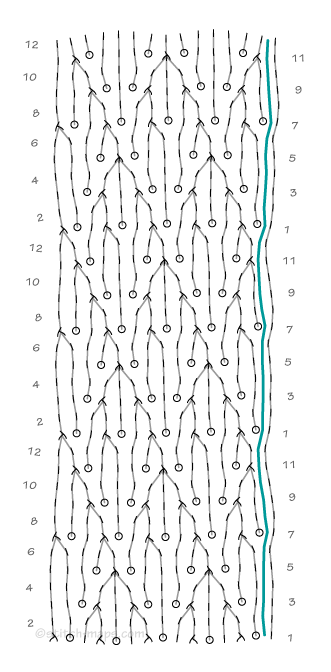
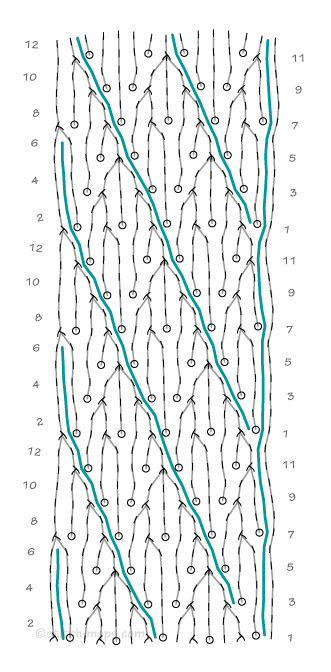
But you’d probably want to know that you could put markers in these spots. They’d gradually move to the left, such that every 12 rows you’d have to add a marker at the right edge, and remove one from the left edge.
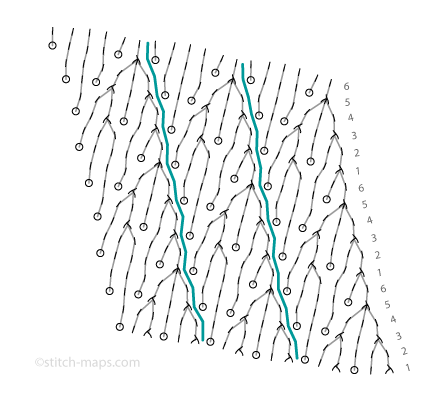
More to the point: if you wanted to work Trellis Lace in the round, this would be the easiest way of doing it. Yes, the patterning would spiral, but note the repeat is only 6 rounds, not 12.
So what options should Stitch-Maps.com offer? What sort of visualizations should it make possible? I’m going to keep cogitating on the matter. Of course, if you have any comments to share, I’d love to hear them!
You know how I’ve said that I drew stitch maps by hand, long before developing Stitch-Maps.com? Well, I found a little proof today. And it was a little surreal.
While cleaning out some dusty corners of my laptop’s hard drive (because, you know, I was stalling on more important tasks), I came across some notes I wrote to myself in 2005, after attempting to draw a stitch map for Oak Leaves and Acorns. It’s a gloriously intricate stitch pattern whose dense written instructions take up an entire page in Knitting Counterpanes by Mary Walker Phillips, but for which I’d never seen a chart of any sort. And I wanted to see a chart.
I wish I could show you the stitch map I drew then. No doubt that scrap of paper has long since been lost in my… ah, how shall we phrase it?… idiosyncratic filing system. But I do have those notes. And, almost ten years on, they’re kind of spooky in their predictions. Here they are, lightly paraphrased:
Notes to self, July 11, 2005
Tidbits learned while creating free-form charts for Oak Leaves and Acorns:
- Drawing is a pain. On the first go, you have to guess at the spacing for the stitches. And you have to count and re-count stitches to make sure you’re on track.
- Re-drawing is a pain: tedious, error-prone, still requires a fair amount of counting and futzing. But it leaves a better-looking chart. And it really helps you understand the pattern.
- Following is a pain, if you want to count stitches (say, on WS rows) to verify that you’re on track. But if you want to use landmarks, free-form charts are the best.
- Regardless, free-form charts are still the greatest thing since sliced bread for charts where the stitch count varies: you can see what bulges and where. They’re also great for patterns where the yarn overs and decreases aren’t adjacent: you can see what leans left and what leans right.
- For patterns like Oak Leaves and Acorns, where the various chunks flow into one another (for example, the acorns don’t line up vertically; instead, the acorns and leaves flow into the central stem), regular gridded charts are a serious problem. You can show the central stem, and you can show each individual chunk, but you can’t show the flow from the chunks into the central stem.
- Though you’d want the rows of a free-form chart to bend as the knitted rows would bend, this makes it difficult to follow the chart by covering the as-yet-unknit rows.
How do these observations impact plans for free-form charting software?
- Software that does the drawing/re-drawing, positioning, and some of the counting would make the job way faster and easier. (Would it lessen one’s ability to “learn” a pattern via charting? Maybe, maybe not: maybe, by making it easier to “play” and ask “what if?” questions, the software would increase one’s ability to get familiar with a pattern and its variations.)
- It may not always be possible to create a good gridded chart from a free-form chart, even with user assistance.
- It might be interesting to develop software with the ability to draw completely free-form charts (that is, charts whose rows bend and sway) or semi-constrained charts (whose rows only run in straight horizontal lines).
Bizarre, huh?
Of course, in keeping with the ought-to-be-doing-something-else theme, I had to map Oak Leaves and Acorns today.
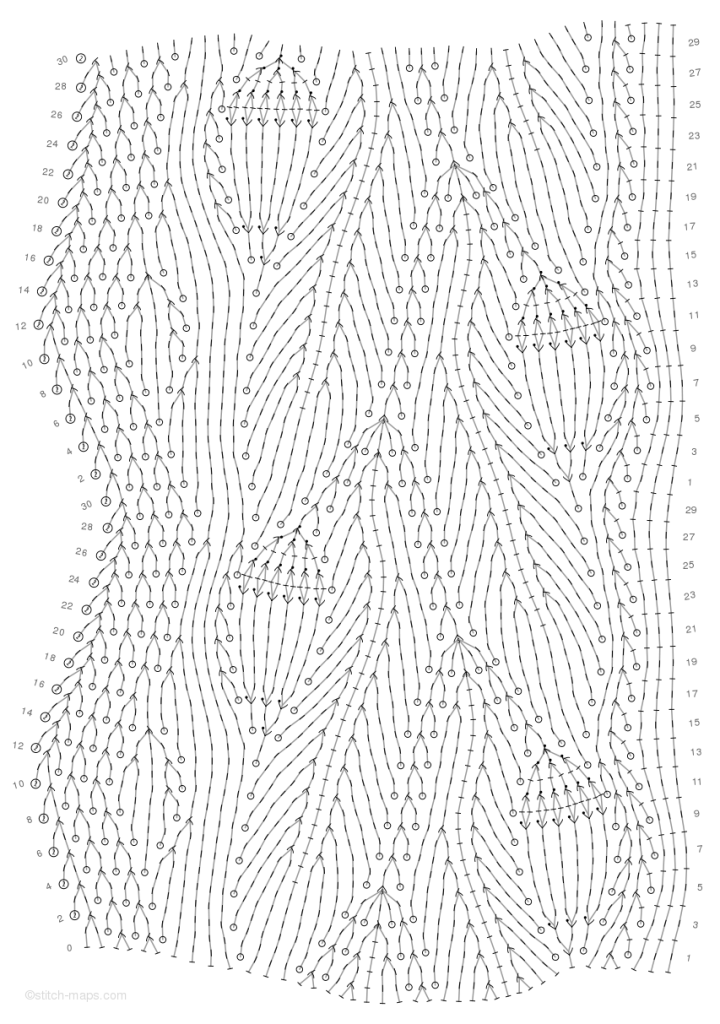
Is that not the coolest thing? And while the long-lost, ugly, hand-drawn stitch map probably took hours to complete, this one only took minutes. Yay for technology!
Check out the latest addition to my knitting bookshelves:
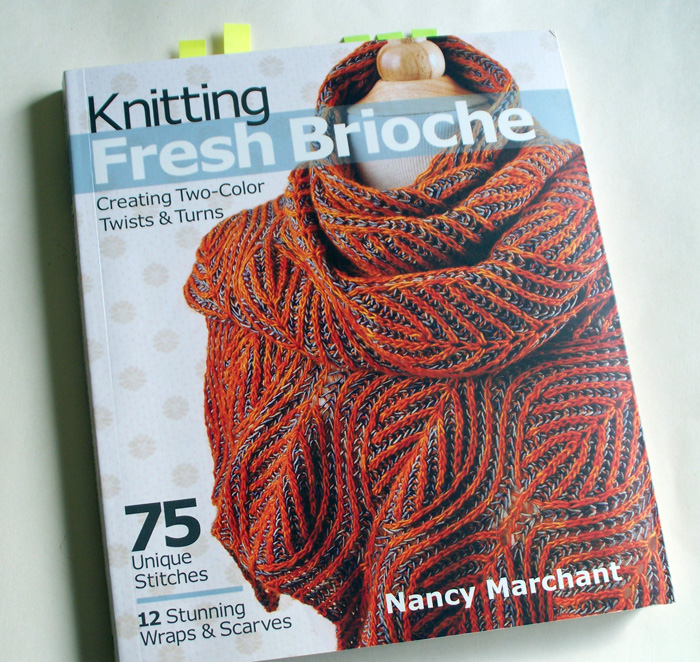
with “gotta swatch now!” pages already marked
It’s Knitting Fresh Brioche by Nancy Marchant, and it’s fabulous.
The book is all about two-color brioche rib. You’d think that kind of narrow focus would be dull – after all, Nancy’s previous book, Knitting Brioche, covered all kinds of brioche fabrics – but no, Nancy makes it clear there’s plenty to explore: oodles of amazing stitch patterns, all formed of increases and decreases on a backdrop of two-color brioche rib, and a dozen stunning patterns for scarves and wraps.
Of course, the book also contains all the technical how-to info you’d need, from casting on and fixing goofs to binding off. My favorite tips are those for creating neat, tidy selvedges – something that I’ve always found tricky with two-color brioche worked flat. Nancy’s approach is to work the selvedge stitches in stockinette when working light color (LC) rows, and to slip them with yarn held to the dark side (DS) when working dark color (DC) rows. Doing so means that the DC yarn gets caught by the LC selvedge stitches… perfect!
That said… I’ve never been one for following instructions exactly. With a little swatching, I discovered I could work chain selvedges on the LC rows, while still slipping those stitches on DC rows. It’s a little fiddly, since the selvedge stitches are essentially only being worked once every four rows. But it’s giving me selvedges that I like, which is what counts, right?
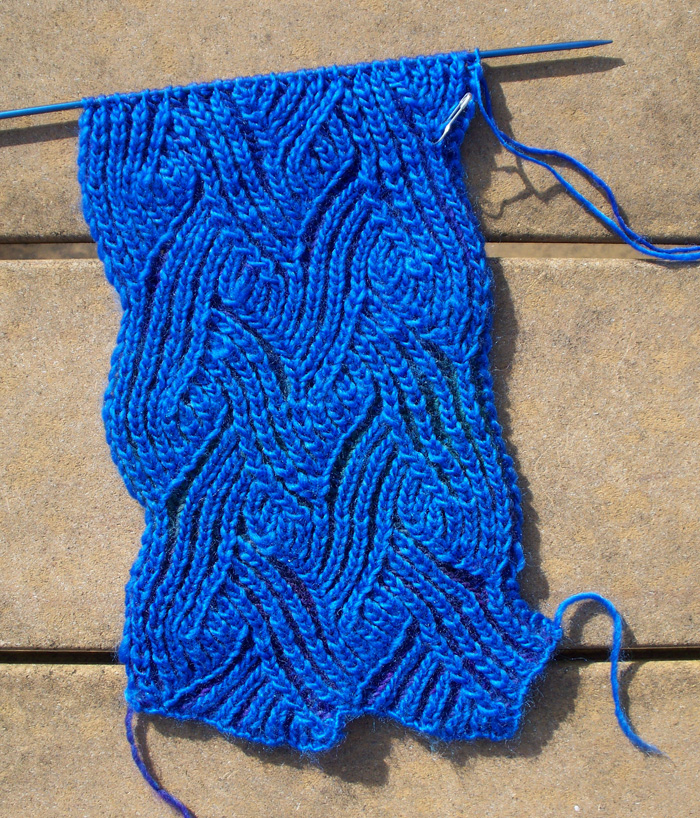
scarf-in-progress, light side

scarf-in-progress, dark side
Let’s say you want to design a shawl composed of lace wedges. You have a lace pattern in mind, and you want each wedge to grow by two stitches on each right-side row. How do you get that lace pattern to fit into that wedge shape?
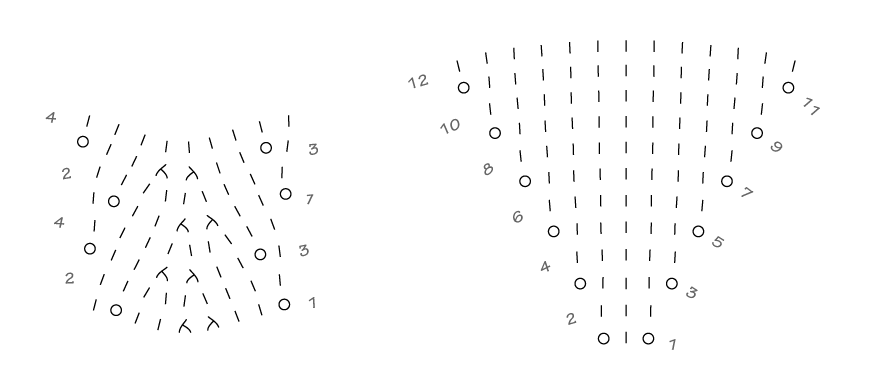
square peg, triangular hole
In Traditional Knitted Lace Shawls, Martha Waterman suggests making the wedge bigger until you have enough stitches available to work another repeat of the pattern.
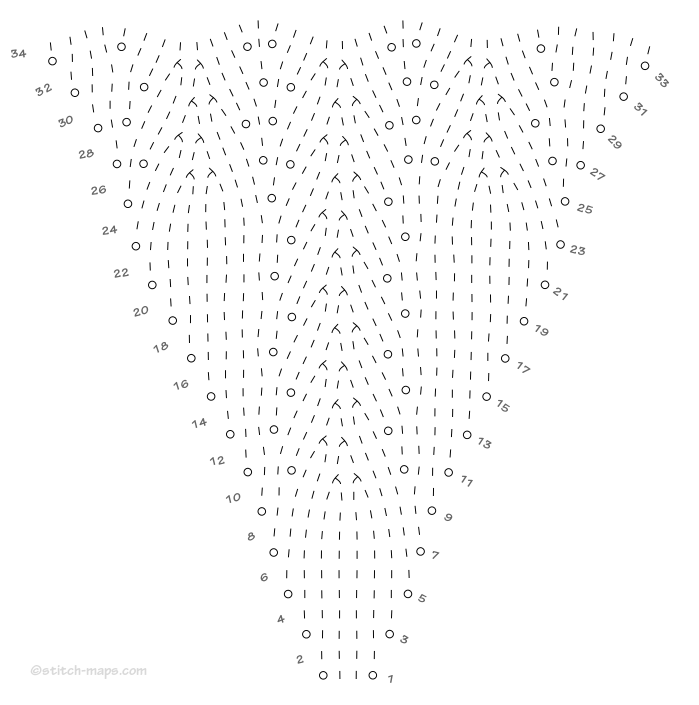
with full repeats of the pattern fitted in when possible
But doing so leaves blank areas that I find… unsatisfying.
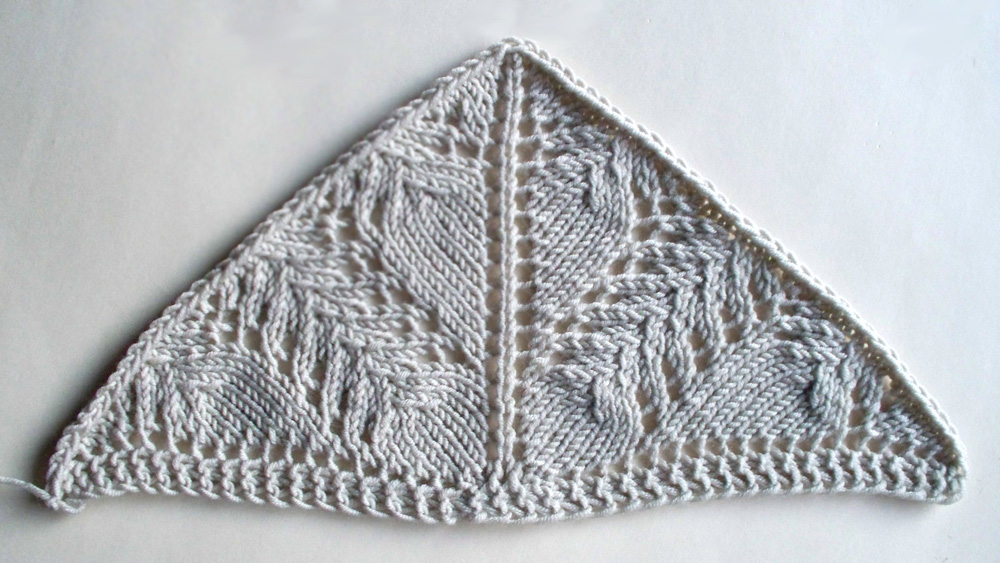
meh
Another option is adding in yo/dec pairs – rather than full pattern repeats – when enough stitches become available. You hear this advice frequently because, frankly, it’s relatively easy to do. But for some stitch patterns, that doesn’t make much of a difference.
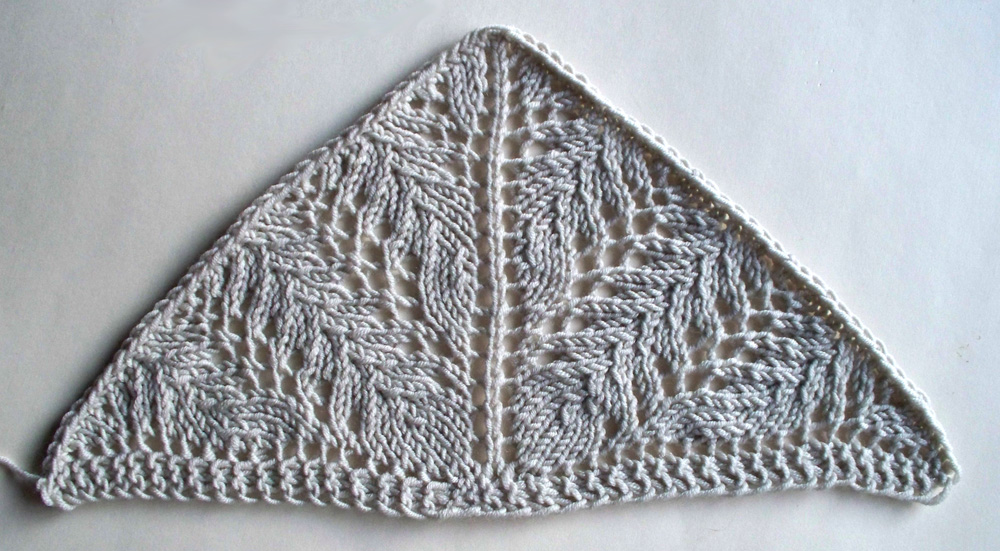
not much better
I like going a step further. I relish the challenge of filling in those blank areas as much as possible, while still maintaining the character of the stitch pattern.

now that’s more like it
This was actually a big topic of discussion during the Wedge Shawl Design class that I taught at Stitches West last weekend. We worked through a few examples as a group, and everyone had a chance to play with the stitch pattern of their choice. Many lovely wedges were created. (Alas, I didn’t get photographic proof, as I never remember to bring a camera to class.)
Still, it bothers me that I can’t quite articulate exactly how to design lace wedges without blank areas. I haven’t figured out a foolproof method that works for all kinds of lace patterns, just tips and tricks that work for some patterns. But I’ll tell you what: I’ll keep fiddling around with lace wedges, and if I make any great discoveries, I’ll let you know. Okay?
Yesterday, while scoping out the knitting shelves at a local bookstore, I found a gently used copy of Martha Waterman’s Traditional Knitted Lace Shawls. Since I’m in the middle of updating my Wedge Shawl Design class, I had to get it.
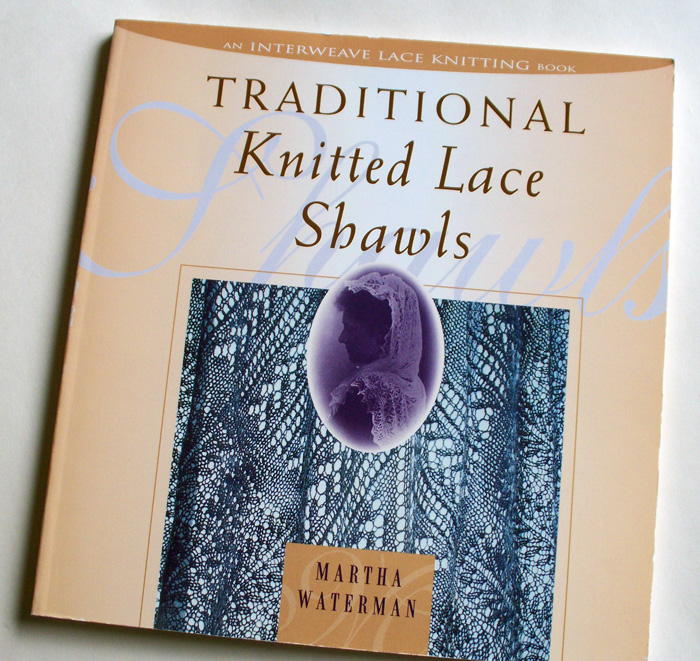
The book has a lot going for it: history, design advice, a nice selection of stitch patterns, a section on caring for your shawls, and more. But right now, I’m smitten with this quote from the “Shaping Shawls” section:
In addition to triangular, shawls can be square, rectangular, circular, or half-circular. You can think of all these shapes as composed of triangles.
Why, yes. I couldn’t have said it better myself. I’ve been having fun these last few days, imagining all the ways that triangles can be combined into other shapes (and how best to arrange a class on the subject!). And Waterman’s book has given me a couple more ideas.
Want to take the class? It’s already sold out at Stitches West, but there’s still space available at Stitches South. And I get to teach it again in August at Jackson Hole Knits, a new retreat in (where else?) Jackson Hole, WY. Whoo hoo! This ought to be fun; I’ve never been to Wyoming before.